Photo Storybooks vs Scrapbooks: Which One Your Kids Will Reread

What You Need to Know
- A photo storybook's fixed sequence, same words, same pages, same order, is what makes children ask for it again and again.
- When a child already knows everyone in the book, each reread builds on the last. That's the loop that drives early literacy gains.
- Building a scrapbook takes hours over multiple sessions. A photo storybook can be finished in one short sitting on your phone.
- Parents tire of published titles well before children do. A refreshable format could add new pages for the adult without taking away the familiar pages a child repeats.
- A scrapbook's cost spreads across separate purchases: the album, paper, stickers, adhesive, photo printing. No single price to see upfront.
- A photo storybook can be reordered for grandparents or shared by digital link. A physical scrapbook stays in one place.
- Old and new pages in a refreshable keepsake could make a child's development visible over time.
Why Your Child Asks for the Same Book Every Night
The book your child wants read every single night is not a problem to manage. It's how reading works. As this piece on rereading explains, familiar stories let children predict what's coming next, and that predictability frees up mental energy for deeper understanding. First time through, a toddler follows the plot. By the fifth reading, they're finishing sentences and catching details they moved past before. That's mastery, not boredom.
That matters when you're weighing photo storybooks vs scrapbooks as something your child might actually return to.
How the Two Formats Hold Up at Bedtime
A scrapbook has real warmth. Photos, stickers, handwritten notes all in one place. A preschooler can trace a grandparent's handwriting, and that tactile quality is worth something. The tradeoff is convenience. A scrapbook is harder to open at 7:30 on a school night, take on a road trip, or share with family who live far away.
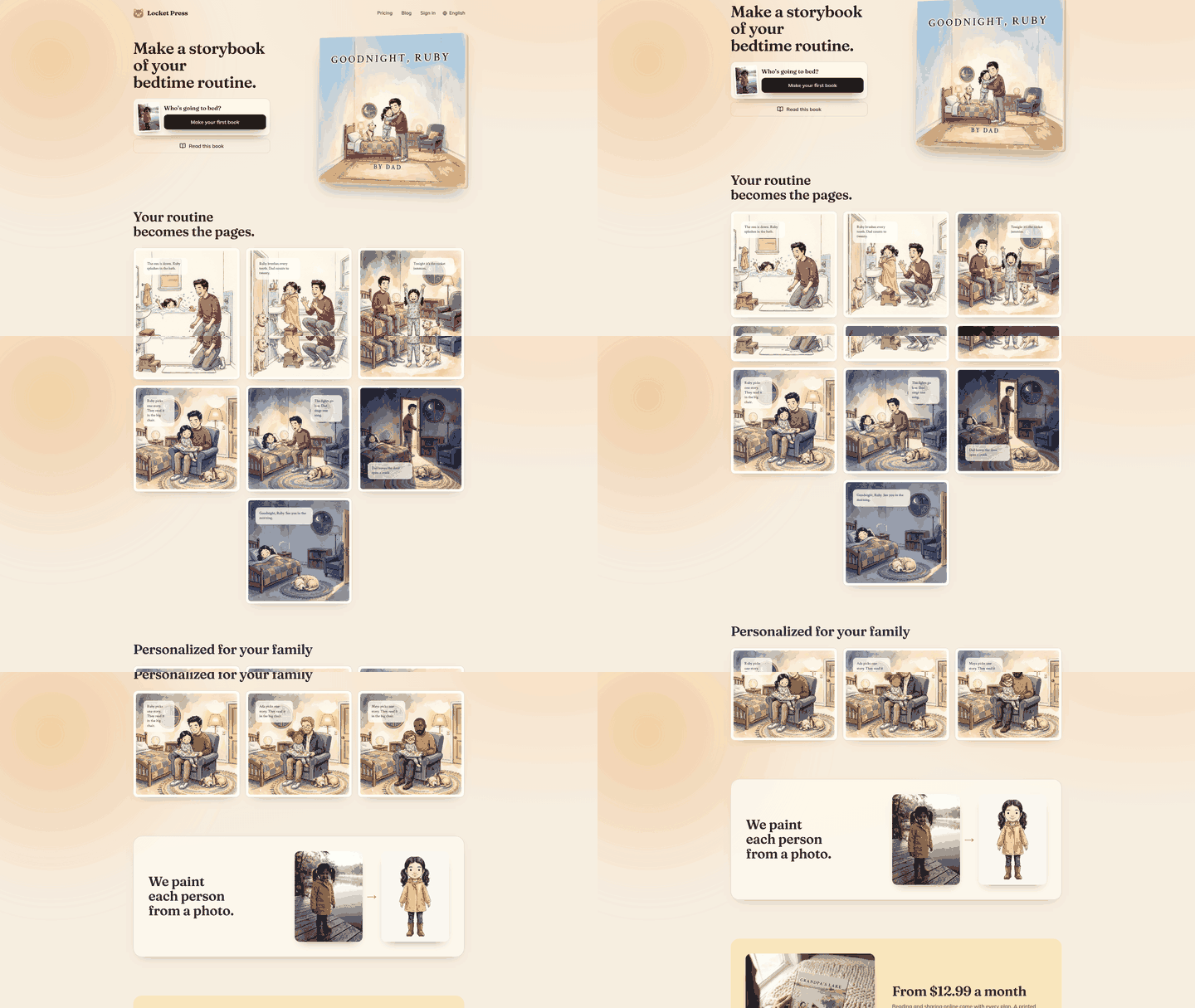
A photo storybook works differently. Same words, same faces, same pages in the same order every time. Each pass lets a child build on what they already understood, noticing more as they go. When the book is about your own family, the child already knows the people and events, so less of each reread has to go toward working out who is who and what happened. More attention may be available for language, sequence, and details—the mastery loop that drives early literacy gains.
| Photo Storybook | Scrapbook | |
|---|---|---|
| Bedtime reading | Easy to read start-to-finish | Less convenient nightly |
| Shareable | Can reach family via a digital link | Stays in one physical place |
| Tactile engagement | Pages to turn, familiar faces | Stickers, textures, handwriting |
| Narrative flow | Fixed sequence, same each time | Browsable, non-linear |
The adult side of this matters too. Parents tire of the same published book well before their children do. A refreshable keepsake is one general format possibility: adding new pages could give the adult something new while leaving the child's familiar pages available for repetition. Old and new pages together could also make the child's development visible over time. For more on how print and digital formats fit into that tradeoff, we've written about choosing between print and digital formats in more depth.
How the Two Stack Up: Time, Cost, Durability, Rereadability
Time is the biggest gap. A scrapbook asks for hours spread across weeks — gathering supplies, printing photos, arranging and decorating each spread. A printed storybook compresses that into a short sitting on your phone.
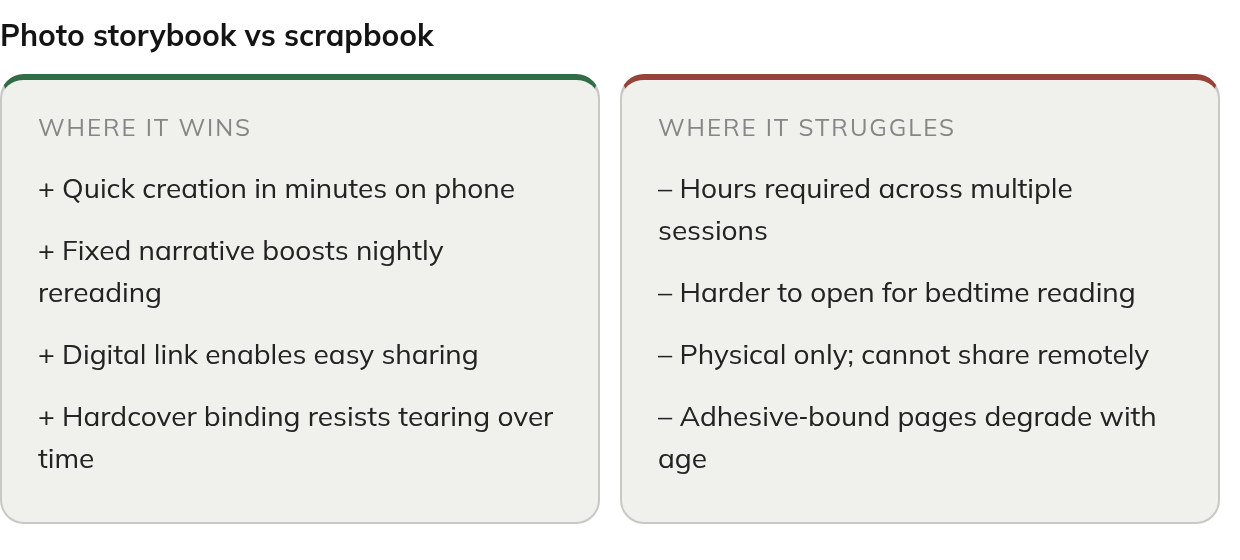
Here's how the two compare across what parents care about most:
| Dimension | Scrapbook | Photo Storybook |
|---|---|---|
| Time to create | Hours across multiple sessions | Minutes in one sitting |
| Cost components | Album, paper, decorations, adhesive, photo printing | Book printing, optional upgrades, shipping |
| Personalization depth | Hand-placed photos, handwritten notes, stickers | We paint each person from a photo, add names and family details |
| Durability | Paper pages, adhesive, hand-placed decorations | Hardcover binding, printed pages |
| Reread potential | Tactile browsing, not a narrative arc | Follows a story a child can track night after night |
| Sharing | Physical only unless you photograph pages | A book you can reorder for grandparents |
Where a Scrapbook's Cost Hides
A scrapbook's price tag lives in pieces. The album is one purchase. Decorative paper, stickers, and adhesive are separate trips. Photo printing adds another step and another receipt, and those costs accumulate before the book is even finished. A printed storybook rolls everything into one price you see upfront.
Why Rereading Tips Toward a Book
Brightly's analysis describes the same pattern the rereading research does: a child returns to a fixed, familiar story night after night, and each pass deepens comprehension and vocabulary. The catch both sources flag is that the adult eventually tires of that same book. A storybook about your own family may ease that adult fatigue without changing the fixed sequence the child returns to. Because the child lived the story, each reread may strengthen autobiographical memory alongside the language skills repetition builds.
Building on the rereading research and Brightly's analysis, one qualified possibility is that rereading lived experiences may support emotional regulation and autobiographical memory alongside comprehension and vocabulary. The child already knows the people and events, so each pass can require less effort to reconstruct the story and leave more attention for rehearsing a personal memory and the language attached to it.
Which One Is Right for Your Family?
The question parents usually land on: who is this for, and what will they do with it?
A book your two-year-old reaches for every night calls for structure and familiar faces. That's what a photo storybook gives you. We paint each person from a photo, so the child sees people they know in a story they can follow from page one. It belongs in a toddler's hands, not on a shelf.
A book that captures a trip, a holiday, or a first year, with handwritten notes and ticket stubs, calls for something built by hand. That's the scrapbook's job. For a hands-on family art project, skip the photo storybook. The two serve different purposes entirely.
Which Fits Your Situation
| Your situation | Better fit |
|---|---|
| Short on time, want it done this week | Photo storybook |
| Want to include physical mementos | Scrapbook |
| Buying a gift that gets read at bedtime | Photo storybook |
| Making a holiday project with the kids | Scrapbook |
| Sharing easily with relatives who live far away | Photo storybook |
| Preserving handwritten notes and memorabilia | Scrapbook |
The two aren't competing for the same job. Families who want a bedtime staple start with a photo storybook. Families who want a keepsake they build together reach for the supplies. A Locket Press book takes minutes to make, so it doesn't have to be an either/or decision.
Make your first book in minutes at locketpress.com.
Start With the Book Your Child Will Reach for Tonight
When parents ask us about photo storybooks vs scrapbooks, we come back to one question: what will your child reach for tonight, and next Tuesday, and the week after that?
If the answer is a story with their own people in it, one they can follow from page to page, a photo storybook is the right fit. We paint each person from a photo you already have on your phone, draft the story from a sentence or two, and you change anything that doesn't feel right before it's done.
If the answer is something you build over several evenings, with printed photos and your own handwriting, the scrapbook wins. We said that plainly above and we mean it. A scrapbook is a project. A storybook is a book you read.
What We'd Do First
Ready to try? Pull up a photo of each person and tell us the story in a sentence or two. We'll draft the pages and paint your family in. Read it together, change anything you want, and see if it's the book you hoped for.
Make your first book in minutes at locketpress.com.
References
[1] Why Kids Ask for the Same Book Again and Again—and Why Rereading Is ... - https://mayasmart.com/rereading-kids-books/
[2] Why Reading the Same Book Repeatedly Is Good for Kids - https://www.readbrightly.com/why-reading-the-same-book-repeatedly-is-good-for-kids/
FAQ
1. At what age should I choose a photo storybook over a scrapbook?
Toddlers and preschoolers benefit most from a photo storybook. The fixed sequence and familiar faces give them something to build on with each reread at bedtime, and that repetition is what supports early literacy. A scrapbook captures trips and milestones with photos and mementos you place by hand, which is a different kind of project.
2. Can a scrapbook work as a bedtime reading book?
A scrapbook lacks a narrative arc, so it is harder to read start to finish at bedtime. A child can browse pages and touch stickers, which has real warmth, but the non-linear format does not give kids the predictability that drives them back to the same book night after night.
3. Should I make a photo storybook or a scrapbook, or can I do both?
You do not have to choose. A photo storybook can serve as a bedtime staple, while a scrapbook can preserve a holiday or trip as a project you build by hand.